

Scott Galloway is wrong about dads and childbirth
He called it “disgusting” for fathers, but that’s not what my research has found

Scott Galloway thinks that fathers should skip their children’s birth. As he said to Derek Thompson on his podcast last week, “I don’t believe men should be in the delivery room – I thought that was so disgusting and unnatural. I wanted them to bring me a baby with a bow in its hair while I smoked a cigarette….It just sucks for the dad.” Thompson, making his first podcast appearance after two months of paternity leave, valiantly pushed back, but Galloway was unconvinced, going on to say he also thinks dads are a “waste of space” in the early months and paternity leave is pointless, too.
In my newsletter last week, I attempted to rebut Andrew Tate’s claim that involved dads have been “cucked by females” into “playing pattycake.” I didn’t expect that a week later, I’d be arguing with one of the “good guys,” a left-leaning podcaster who has expressed appreciation for feminist progress. But people kept tagging me in posts about Galloway’s remarks,1 and, as it happens, there’s a whole chapter on men’s experience of childbirth in my forthcoming book.2 For the chapter, I interviewed my dad about his experience of my birth, which was such a medical misadventure that he had to scrub in and help perform emergency surgery.3
Although my dad’s experience was unusual, many men find that witnessing the birth of their children can be deeply meaningful but also scary, stressful, and even, as Galloway puts it, “disgusting.” Celebrity chef Gordon Ramsay, best known for yelling at hapless line cooks, skipped his children’s births so his sex life wouldn’t be damaged by “images like something out of a sci-fi movie - skinned rabbits and conger eels coming at me from everywhere.” Since Ramsay regularly cooks with entrails, you’d think the rabbits and eels would be a draw, but apparently not when they represent his own children.
Galloway actually has a decent point when he calls the presence of fathers at birth “unnatural.” Dads have not been welcome in the delivery room for much of our human history. To be clear, birth has always been a social event. When we evolved to walk upright, the human pelvis narrowed and childbirth got tricky. Thanks to the complexity of steering a giant-headed infant out of a tight space, we need helpers during labor and delivery. This makes humans different from most animals, who deliver their infants unassisted. But for most of human history, childbirth attendants have almost always been female. Before the medicalization of childbirth, most births happened at home, in the company of a midwife and a woman’s female relatives. Men generally stayed at a distance.
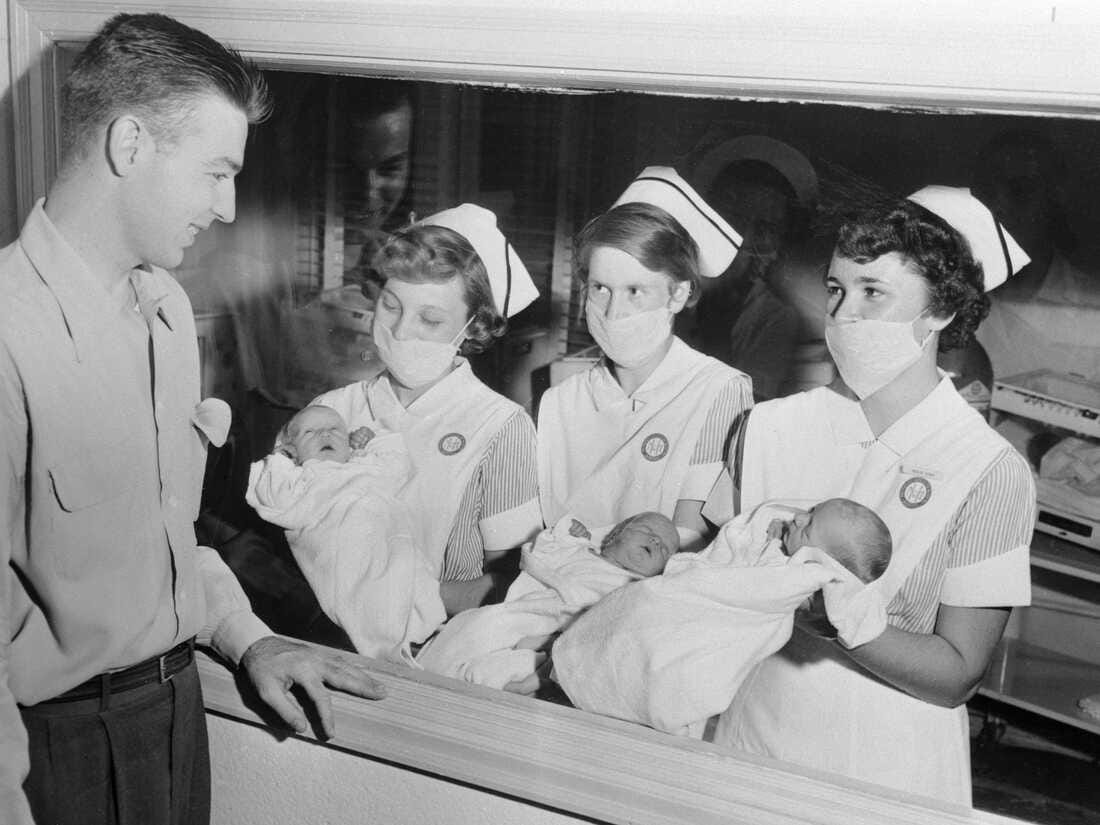
Even after birth became a medical affair and moved into hospitals, under the supervision of doctors (who were, of course, always male in the early days of medicine), it was still not “normal” for dads to attend birth. The stereotypical 1950s trope of the dad who is handing out cigars in the waiting room, or gazing at his baby through the glass wall of the nursery, was a good approximation of the real status quo.
Not only did birth become medicalized in the first half of the 20th century, but it also became heavily medicated. Remember when Daisy Buchanan talks about her baby daughter’s birth in The Great Gatsby? Here’s the full passage:
Well, she was less than an hour old and Tom was God knows where. I woke up out of the ether with an utterly abandoned feeling and asked the nurse right away if it was a boy or a girl. She told me it was a girl, and so I turned my head away and wept. ‘All right,’ I said, ‘I’m glad it’s a girl. And I hope she’ll be a fool—that’s the best thing a girl can be in this world, a beautiful little fool.’
It’s a tragic passage, as befits a tragic character, but Daisy’s description of waking up “out of the ether,” not knowing the sex of her own baby, would not be atypical for a woman of her time. “Twilight sleep” anesthesia, once common in obstetrics, sedated women so completely that they often awoke after delivery with zero memories of their own children’s births. Obstetricians often had to use forceps to pull children out of their unconscious mothers, leading to birth injuries for both mother and baby.
Although “twilight sleep” made life easier for doctors and nurses (full sedation means no complaints!), many women actually wanted to remember their baby’s birth. And they wanted their husbands’ support as they labored.
Men’s entry into the delivery room, which occurred in the 1960s and 1970s, was really the result of both mothers and fathers advocating for the inclusion of fathers. And in the relatively short time since then, it’s become an expectation that dads will show up. Indeed, fathers are often the primary support partner, taking the place that was once occupied by sisters, aunts, grandmothers, and other women. It’s yet another example of how the community networks that used to participate in alloparenting have now shrunk down to put all the pressure on mom and dad.
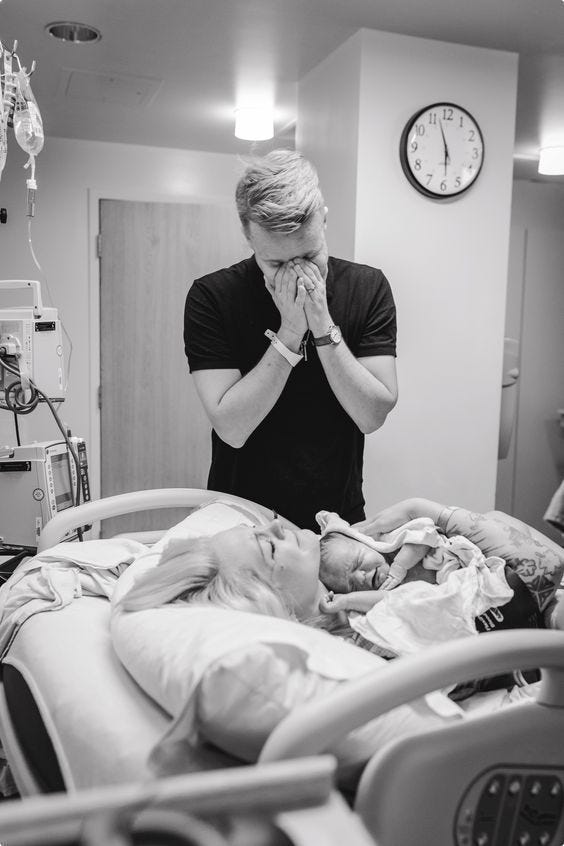
Because there aren’t lots of other support partners around, fathers today fill an important role in labor. We know that social support can reduce moms’ fear and stress, which then directly affects her experience of pain and even the timely progression of labor. Moreover, men themselves often say that they don’t want to miss out on their baby’s birth. In fact, men who witness childbirth describe it as meaningful and even transformative. A 2020 study of German fathers found that 94% of them said they were happy to be present at birth, and 80% of them thought that they benefited from attending their child’s birth. However, a minority felt helpless, overwhelmed, and even traumatized by births that went awry.
Despite the psychological (and physiological) complexity of childbirth, there’s not much research on how it connects to the overall quality of the couple relationship. There’s also little research on its mental health effects, especially for dads. In fact, I’ve been calling for more work in this area for years, and my lab has done a bunch of studies on childbirth. You can read all about them in my book, but to quickly summarize a few: In one study, we found that when men described their partner’s childbirth as more stressful, they had worse symptoms of postpartum depression six months later, even when we controlled for their prenatal depression. In another study, pregnant couples who argued more negatively during a conflict task in our lab subsequently had more difficult childbirth experiences several months later, suggesting that the tenor of the couple relationship may have shaped how they navigated labor.
In one of my favorite projects from my lab’s transition-to-parenthood study, we looked at how couples told their birth stories. We collected these narratives by visiting couples in the hospital or birthing center within a day or two of their child’s birth and asking them to describe their experience, which we audio-recorded. In some cases, we heard couples’ birth stories even before friends and family did. When we analyzed these narratives, we found that their birth experiences were deeply meaningful for the dads. Many dads said that they felt changed or transformed by their experience of witnessing their baby’s birth. Dads who found the birth more meaningful even reported less parenting stress six month later.
So, in attempting to shield themselves from the yucky stuff, dads like Galloway and Ramsay may be missing out on an opportunity to forge a bond and find meaning. Moreover, their impulse to skip it reflects a larger misapprehension of what having a baby is all about. Parenting, after all, requires a lot of yucky stuff. But it’s ultimately the yucky stuff that makes us fully human.
MUSIC RECOMMENDATION OF THE WEEK
Past recs (Playlist link!): Broncho // Alvvays // Capitol Years // The Cairo Gang and Hard Quartet // The Beths // Ballerina Black // James Mercer // Playboy Carti & Car Seat Headrest // Weyes Blood // Matthew Sweet // Fontaines D.C. // Elvis Costello Spanish Model // Lily Allen // Geese // Olivia Tremor Control // Wake Up Dead Man // Beulah // Rosalia // A$AP Rocky // Dirty Projectors // Mitski // Foxygen // Teenage Fanclub
AIMEE MANN
Saturday was Valentine’s Day, and, although I’m happily married, I think the best thing to do on Valentine’s Day is to drive around crying while you listen to sad love songs. I took my daughter to see Wuthering Heights, and played Aimee Mann’s 2005 album The Forgotten Arm in the car.
I like to use this space to recommend music that will make me seem cool and hip, and I briefly talked myself out of recommending Aimee Mann because she has kind of a boomer mid-tempo easy-listening kind of reputation. But then I got mad, because that’s so unfair to Aimee Mann, who is a straight-up genius and one of the most underrated artists of the last 30 years in my opinion. Vocally, I think she’s the closest heir to late-period John Lennon, with that flat, nasal, sardonic delivery.
I think The Forgotten Arm is a total masterpiece. It’s a song cycle about a doomed love affair between a boxer named John and a woman named Caroline that descends into addiction. It has bummer songs like this one:
And this one, which is even more depressing.
In writing this rec, I looked up reviews of the album when it first came out, and it made me even more mad. Critics were so dismissive. The Onion’s A.V. Club called it “clichéd and exhausted.” Pitchfork used the word “Ho-hum.” Forget you, clowns! I think everyone wanted to take Mann down a peg after the big success of Magnolia, but, just like Scott Galloway on childbirth, they are WRONG. This album is epic.
Thanks to Eve Rodsky and Corinne Low for being the first to bring this to my attention!
I’ve probably never mentioned my book in this newsletter before because I’m being extremely cool and normal about the fact that IT’S COMING OUT IN LESS THAN FOUR MONTHS GAAAHHH. Honestly I’m embarrassed that I’m being so annoying about promoting my book at every turn and I thank readers for their patience. It’s a weird time in publishing, you guys. But also, I really did write about this in the book!
To get the whole story, you’ll have to read the book, but thankfully she recovered and eventually had these two adorable weirdos.
It shows such cowardice to not want to be there for your wife during what will always be among the scariest and emotionally charged days of her life. I also can’t imagine not wanting to be in the room to see your new child.
It’s just a loveless, selfish perspective and I hate that he is hiding behind a pathetic notion of masculinity while encouraging other men to be cowards like him.
It's also crucial that someone is there to advocate for the person giving birth. Ideally, it's their partner, the other person responsible for this new life. So much can go wrong during the process and medical providers will too often listen to a man over a woman, even under the best circumstances.