

Interplanetary communication: Leaving Mars and Venus behind
Natal Gazing weekend edition featuring feminization, cookies, and movies

This newsletter is coming in late this week because I made 100 key lime pie inspired cookies for a high-stakes cookie swap and it nearly killed me. I’ll include the recipe below.
I had a piece in The Argument this week, unpacking the science on gender differences. (No paywall, so you can read it for free, but also, subscribe to The Argument!). I argue that Men are from Mars, Women are from Venus style thinking – rooted in the assumption that the genders differ in large, intractable ways that fundamentally drive behavior – has made a roaring comeback lately. Take Helen Andrews’s viral “Great Feminization” theory that women have ruined institutions with their intolerance for truth-seeking debate. Although it’s easy to find flaws in Andrews’s argument, it’s energized a corner of the internet that is always eager to dunk on women. On X, a lively #Repealthe19th contingent wants to roll back women’s voting rights and cap women’s hiring. But even less overtly misogynist gender discourse – like tradwife nostalgia – comes from a strong conviction that the sexes are fundamentally very different: built for different work, shaped by different values, destined for different lives. Ergo, feminists are bad because they defy the natural order of the universe. Dig in a little more and this message is not just found in politically charged spaces, but all over social media. Whether your algorithm is feeding you parenting content or relationship content or science content or fitness content, a familiar format goes like this: “Did you know? Men do X and women do Y because of [insert brain or hormone difference here].”
But, as my piece argues, if you dig into studies on gender differences, they don’t always point to a strong deterministic role for biological sex in explaining most human traits. Yes, our physical bodies are differently sized and shaped, and yes, we have different reproductive functions and drives.1 But look at most types of cognition and behavior, and you don’t see a strong, sharp divide between the sexes. In my piece, I described a study that statistically weighed evidence for gender differences as “taxonic” – that is, putting men and women in distinct categories – or “dimensional,” spread out along a continuum.2 Data from over 13,000 participants pointed to the “dimensional” solution. Even when males and females fall into different places along the distribution on average, there’s plenty of overlap, and you can always find exceptions to the rule. Cultures devise different forms of specialization to distribute resources and socialize these specializations into gender norms, helping to canalize and reify small distinctions into fixed prescriptions. But in truth, humans of both sexes are flexible, adaptable, and variable, and the genders don’t really live on different planets. The “Mars and Venus” narrative is less useful, therefore, than the reality that both men and women actually live together on earth.
My favorite part of researching this piece was learning more about the early history of neuroscience, which was often used to justify the exclusion of women from higher education on the basis of their smaller and therefore (it was assumed) inferior brains. In graduate school, I learned about Paul Broca, who thought that women were pin-headed dummies, but not about Helen Thompson Woolley, who actually tested the cognitive abilities of men and women back in 1900 and found them equivalent. Those who rail against DEI initiatives sometimes forget why institutions needed diversity in the first place: fields that are dominated by a single group can develop major blind spots. When only men could be neuroscientists, no one had much of a stake in pushing back against sexist science. Only the entry of women into the field broadened the scope of our questions.
I’m perpetually interested in these issues, in part because I was raised by parents who didn’t always fit neatly into gender scripts (cooking was a man’s job in my childhood, for example, and my mom is a science nerd who recently dissected a dead possum that she found in her driveway), in part because I don’t always fit neatly into gender scripts, and in part because I think human plasticity is really cool. I study how men’s brains and bodies change when they become parents, and that research challenges the assumption that only moms are wired with an innate instinct to nurture. The gender essentialism that pervades many parenting spaces bugs me, because it creates a world in which we treat paternity leave as an afterthought and judge men who miss work after their baby’s birth.
I didn’t want to make my Argument piece all about the Helen Andrews “Great Feminization” thesis because a lot of other writers have written terrific pieces about it already (I linked to a bunch of them in a footnote) and because it seems kind of played out at this point in The Discourse. But I do think you could actually do some interesting research on how female participation affects the cultures of particular spaces. My chief beef against Andrews (besides the fact that she’s created a permission structure for misogynists) is the fact that she advances testable hypotheses but fails to engage with actual data. Just spitballing, but here are some fun studies you could do:
—Scrape data from Reddit (or Substack, or X, or any other large platform) and employ latent semantic analysis (or another natural language processing approach) to measure linguistic complexity, ‘emotion’ vs ‘cognition’ words, or ‘cancellation bids’ via gender of poster. Alternatively, to test group dynamics, identify online subgroups or communities that are female-dominated, male-dominated, or at gender parity (say, a home decor subreddit vs an auto repair subreddit) and test for differences in the tone or complexity of conversational exchanges.
—Test whether more male vs female dominated state legislatures (and/or male- vs female dominated national parliaments) pass more evidence-based legislation and/or deliver better economic outcomes over time. You could also use this dataset to test Andrews’s claim that “men developed methods for reconciling with opponents” by coding floor debates and measuring how differences are resolved. You could also code use of emotion vs cognition words in floor speeches or bills written by male vs. female legislators.
—Test whether male vs female dominated academic departments or universities are more selective and rigorous (you could operationalize this by looking at admission rates, average test scores of majors, number of weed-out courses, evidence of grade inflation, etc). Code dissertations for quality of argumentation and compare by gender of scholar and/or research advisor.
—See whether the percentage of female associates in a law firm is correlated with its productivity, earnings, numbers of cases won, or link change over time in a law firm’s gender composition with its outcomes
-Analyze transcripts of speeches from a political convention and code for appeals to emotion and/or rigor of argumentation
-Do an experimental study where you randomize people into teams or classrooms that vary by gender composition and then test performance on specific challenges.
Some studies in this vein already exist. There is actually a research literature within organizational psychology (a discipline often found within business schools) looking at gender diversity and team performance! Why didn’t Helen Andrews look at any of these studies when forecasting how women might ruin institutions? They are so easy to find. For example, a study looked at the male-female compositions of Boards of Directors and top managers in both UK and Chinese companies, finding that greater representation of women was linked positively with innovation and firm performance. Another study finds that when you control for team ability, team gender composition has no impact on performance on a collaborative challenge (specifically, developing business plans). Yet another study finds that mixed-gender teams do better on a challenge task unless they’re under time pressure, in which case the single-gender teams do better, perhaps because they have fewer perspectives to consider. And still another study finds communication differences based on gender compositions of teams: “We find that all-male teams communicate more than all-female teams and outperform teams of both alternative gender compositions. In mixed teams, men strongly dominate the team conversation quantitatively. Considering the ranking in terms of communication shares in mixed teams, we document that high-skilled men talk the most, followed by low-skilled men. High-skilled women talk more than low-skilled women, but much less than low-skilled men.”
This is just a handful of published studies from the last five years or so, and they all have their limitations, but the point is that some of these data are already findable, and other work could be done. You’d just need to approach it with some rigor. Ideally, you wouldn’t just want to operationalize gender composition within organizations by looking solely at numbers and ratios. You could assess where individuals fall on the stereotypical masculinity/femininity continuum; there are well-validated instruments that already do this. Andrews’s original piece hones in on law firms and universities as two types of institutions sullied by an influx of women. However, women who go into law or academia may be atypical exemplars of their gender. The whole point of Legally Blonde is that Reese Witherspoon’s uber-girly presentation was anathema to her female law school classmates. The first few generations of female academics had to fight through so many barriers to get their work taken seriously that they often evolved into stern gatekeepers themselves. Within my graduate department, the scariest advisors were not the friendly senior-level dudes, but the ice-blonde Valkyries who grilled visiting speakers. In any case, if you measured average masculinity/femininity norms within a workplace or group, you could then test a whole bunch of other interesting questions.
I have two hypotheses about what these studies would yield. First, in accordance with what the existing work already indicates, I suspect that the workplaces that perform best aren’t particularly male- or female dominated, but show fairly even gender parity. I think we’d see the best performance within those spaces because you’d find a broader diversity of perspectives and behaviors. I also suspect that you’d see a performance advantage for people with a slightly gender-incongruent profile – that is, the particularly argumentative, rational female or the empathetic and collaborative male – because those people will integrate better into a variety of groups. In fact, my pet theory is that a little bit of gender-incongruence makes people more successful as Substack posters - take Helen Pluckrose or Diana Fleischman who I’d argue are more willing to engage in clear-minded debate than the stereotypical female poster, or Jeremy Mohler, Christopher Pepper, or Elliot Haspel, who write about “feminized” topics like mental health and childcare from male perspectives.
That said, we’d need real data in order to see if I’m right!
Before I go, a few more updates on my feminized activities of the week: clothes shopping and cookie baking.
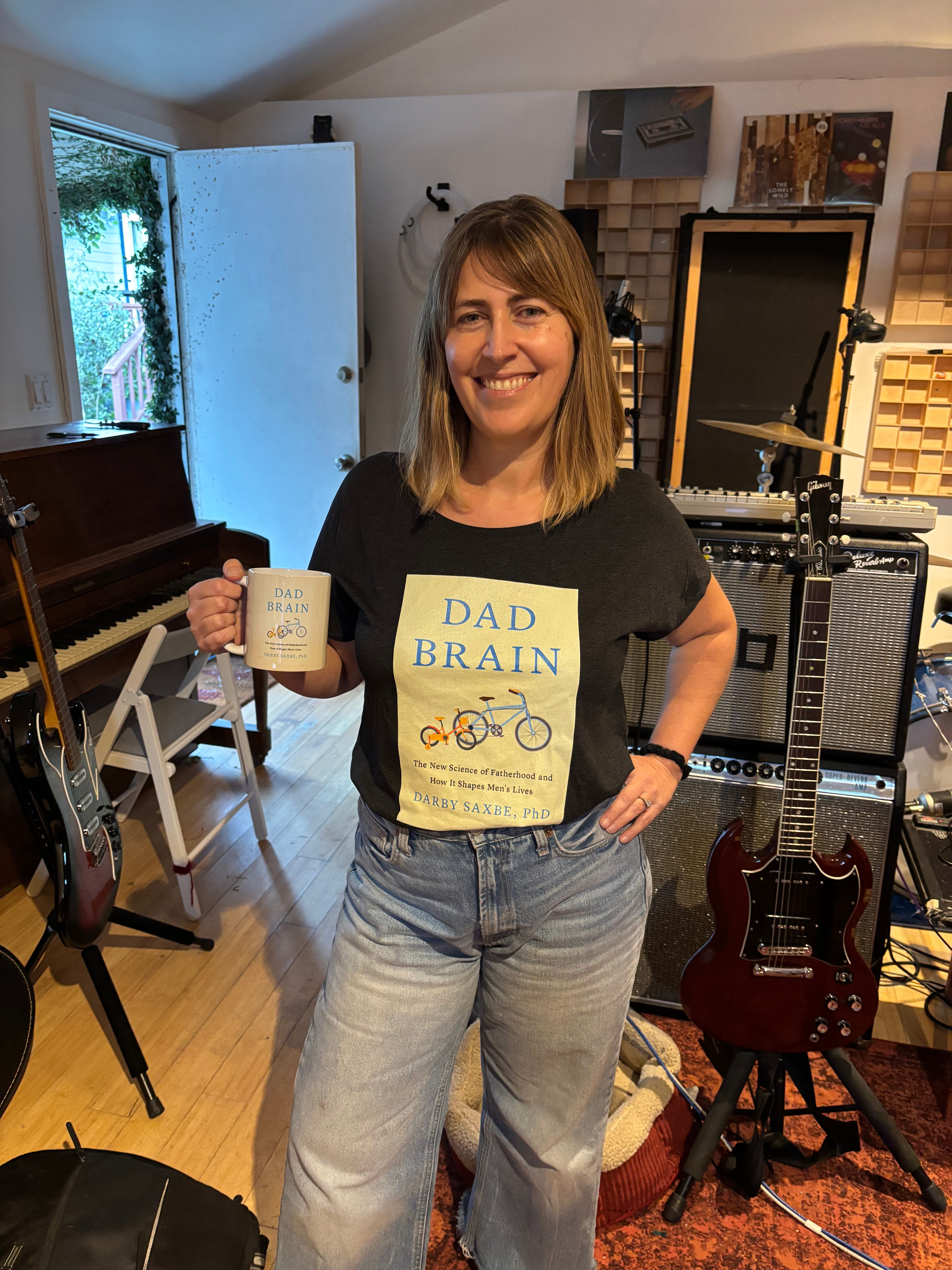
On the clothes front, I’m testing out some possible swag for my book promotion, and I made myself a Dad Brain t-shirt and coffee mug! It’s a little narcissistic to wear a shirt with your name on it, but that hasn’t stopped me from sporting it all over town. I figure you need a little narcissism to sell books. What do you think, a new trend for 2025?
On the baking front, I participated in a high-stakes cookie swap with my most serious baker friends and it nearly broke me. This cookie swap is in its 14th year or so, and these ladies are not messing around. It’s a faux pas to repeat a recipe that someone has already made (I nixed my original cookie choice when someone reminded me that they’d already brought it to the swap back in 2018), so we’re always looking to top ourselves. Every year there’s a flurry of emails when the New York Times, Bon Appetit, and Food & Wine cookie issues come out and we start clipping recipes. We all want to be first out of the gate with the most au courant cookie of 2025. People do test batches just to optimize their cookie choice! I think my contribution was pretty good: key lime pie thumbprint cookies, swiped right out of this year’s Bon Appetit. You make a graham cracker cookie base, indent and chill it, and then fill with a creamy lime pie filling. The problem is that it’s not a very scalable cookie, and I was charged with making seven dozen. Four hours later, I could barely peel myself off the floor to actually go to the swap. But look at these glorious cookies! (The key lime pie ones are in the top right corner).


MUSIC MOVIE RECOMMENDATION OF THE WEEK
Past recs: Broncho // Alvvays // Capitol Years // The Cairo Gang and Hard Quartet // The Beths // Ballerina Black // James Mercer // Playboy Carti & Car Seat Headrest // Weyes Blood // Matthew Sweet // Fontaines D.C. // Elvis Costello Spanish Model // Lily Allen // Geese // Olivia Tremor Control
WAKE UP, DEAD MAN!
Since this is a weekend edition of this newsletter, I’m going to write about movies instead of music this time, especially since this week’s movie choice got me thinking about one of my favorite topics: healthy masculinity.
I love a classic locked room mystery – I had a goldfish named Agatha Christie as a child - so the Knives Out franchise is catnip for me. I especially loved the latest installment, Wake Up Dead Man, and how much it wrestled with opposing visions of manhood.
Wake Up Dead Man opens with a punch: the lead character Jud, a priest played by Josh O’Connor, knocks out a deacon. We learn that Jud was a boxer who found Christ after killing an opponent in the ring. He tells the story of his conversion in body language: he has gone from fists raised in a defensive crouch to open, welcoming arms. The punch is a momentary lapse (the deacon was, famously, an asshole), but Jud has committed his life to service rather than fighting.
The church ships Jud off to a remote parish in upstate New York, where his devotion to service is soon sorely tested. He must serve under Monsignor Wicks, played by a fearsome Josh Brolin. Wicks is a far-right crusader against “modernity” who is presented as a pastiche of Donald Trump and a fire-and-brimstone televangelist. (I should note that I’m not really doing sophisticated film critic reading-between-the-lines here. The movie is extremely on-the-nose and even campy). He roars at his parishioners from behind his lectern about the sins of loose women and wayward youth. His preferred strategy for culling his flock is to single out a church attendee he can publicly shame, such as a single mother who dares to show up with a child and no husband in tow. He forces his followers to prove their fealty by turning against this common enemy. They’ve all become radicalized by their involvement with Wicks’s church, but none of them seem happy about it.
Jud, who wants to serve his flock rather than rule over them, comes to realize that Wicks’s style is toxic and dangerous.
Wicks is styled as masculine – he is a literal patriarch, commanding and controlling his flock in a loud, booming voice, ruling through terror. Jud is also masculine – he is a man of quiet authority, a boxer and a woodworker, skilled and confident – but he leads with empathy and care. When the two men have an angry confrontation early on, Jud visibly struggles against his instinct to put his fists up. His strength is his commitment to peace. At a critical turning point when the mystery is nearly solved, Jud gives up on detective work in order to comfort a lonely woman who needs his prayers.
The central conflict of the film is the showdown between these two modes of masculinity: both leaders, both named Father, one aggressive and combative, and one prosocial and empathetic. I won’t tell you which man wins out, but I will tell you that it’s worth watching.

Although I am suspicious of gender essentialist narratives in most forms, I think an “embodied” perspective on pregnancy, birth, and the postpartum period, as described by thinkers like Leah Libresco Sargeant and Elizabeth Kulze , is valuable and represents important terrain for feminists to navigate. I don’t think we should minimize the importance of motherhood in transforming the female body, although I would argue that fatherhood can also do the same for men.
When groups are taxonic, you can make confident predictions because distinguishing traits tend to cluster together. So, for example, if you’re trying to tell an apple from an orange, and you know that one of your options has a thick, leathery peel, you can also guess that your fruit will be round, juicy, and pithy. In contrast, traits typically assumed to be sex-typed don’t cluster together quite so neatly: you can have good spatial skills but not be aggressive, and you can have good fine motor skills but low interest in babies.
I’m fascinated by the emerging discourse around feminization and workplace sexual dynamics and the possibility of male/female traits. It’s probably still not wise for many men to openly participate but I think it’s healthy that women are.
There is one sharp difference between men and women: women (and not men) can give birth. Ultimately this is their most important function (to society, collectively) and it’s an open question whether the current cultural values that are dear to women can functionally coexist with that important role. In other words, if the modern emphasis on career and education inexorably leads to a situation in which women aren’t maintaining population levels then those values will organically fade away (the society will die)… and be replaced by societies with different (more historically typical) values.
https://jmpolemic.substack.com/p/civilizational-darwinism
Norms and values don’t exist to maximize the freedom and happiness of the individual. They exist to promote the health and order of the society which cultivates them. We seem to have forgotten that.
Here for the Dad Brain Mugs 😏