

Dads really do have more fun
Why fathers seem to enjoy time with kids more than mothers do

“Am I just a monster? It’s been four years since I became a father and I’m beginning to fear for my soul. The truth is I just don’t like being around kids for very long.” Cryptodad Justin Murphy went viral after ranting on X last month that he found a game of catch with his son to be soul-destroying. After ten minutes alone with his children, he wrote, “my blood starts to boil.” The internet went wild, of course, with takes ranging from sincere advice to feminist eye-rolling to threats to call CPS. Even sex trafficker Andrew Tate chimed in with a characteristically nice and normal reply.
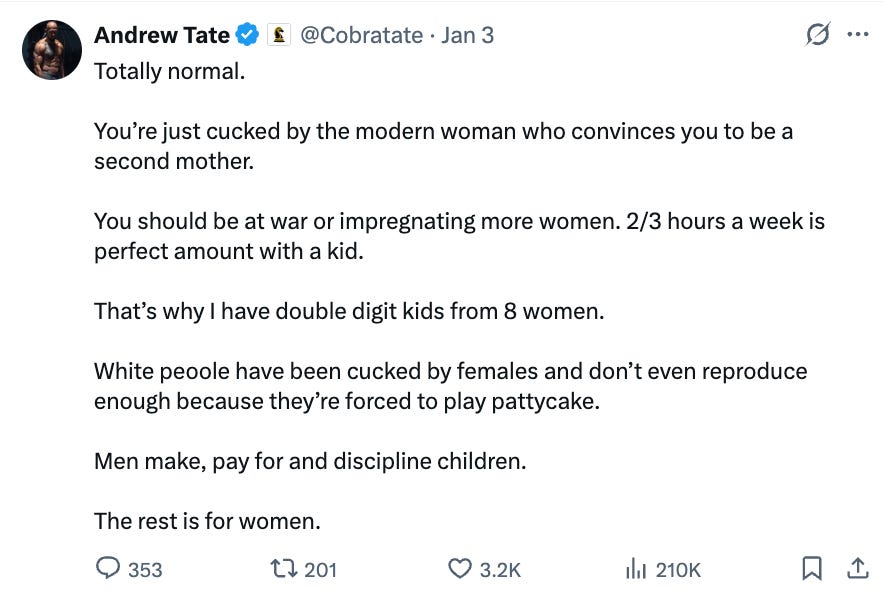
Tate has clearly not read my book (or any of the other great books on fatherhood, like Sarah Hrdy’s Father Time or James Rillings’ Father Nature), because there is in fact fascinating evolutionary and neurobiological evidence that human men are important alloparental caregivers whose brains and bodies adapt to parenthood. (I would send him a galley, but he’d probably consider that a cuck move).
Contra Murphy and Tate, there’s solid evidence that fathers actually enjoy their time with children more than mothers do.
Keep in mind, this may be a low bar. A much-cited 2004 study that sampled 1000 U.S. women found that they rated taking care of children to be their least enjoyable daily activity, ranking it below watching TV, shopping, or cooking. Moms were more tired, stressed, and irritable when with their children. These findings have been corroborated by several other daily-diary studies, although, as a 2014 review concluded, research on parenting and happiness is complex, and depends on whether you’re measuring global or momentary happiness, and talking to parents of young children or parents with older kids. Jennifer Senior’s 2019 book, All Joy and No Fun, built on this body of work, suggesting that when you focus on momentary emotional states, parents experience less positive affect and more stress than non-parents. This is not entirely surprising, if you think about the fact that parenting small children frequently entails cleaning up spilled Cheerios, trying to keep small hands out of the dog’s water bowl, and interacting with people going through a developmental stage in which telling you NO is the most empowering thing they can think to do.
However, these studies aren’t all bad news. In fact, some of the best news is for men: multiple studies have found that fathers derive more pleasure from time with kids than mothers do. One of the biggest and best studies looked at three samples of parents, totaling more than 18,000 participants. Fathers rated themselves as happier than men without children. Moreover, when spending time with their children, fathers reported greater momentary well-being than mothers did. In contrast, mothers said they experienced more daily hassles than women without children, and the study did not find a big life satisfaction difference between mothers and women without children.

There are a number of reasons why fathers seem to enjoy parenthood more than mothers. First, it matters how parents actually spend their parenting time. When dads are in the company of their children, they are more likely to report that they are playing with them. Mothers, on the other hand, tend to do more of the grunt work, like feeding, bathing, and dressing children, all activities that come with more opportunity for pushback from kids. There are some biological reasons for why dads are drawn to active play, but there’s also a big role for socialization: dads can serve as the “play parent” when they are more of a novel presence at home. It’s delightful to swoop in and do something fun with kids while someone else is managing the basic care. That balance is shifting, however, as millennial dads are increasingly taking on basic childcare as well as serving as the Good Time Charlies of the household.
Fathers might also enjoy parenting more because it’s a less fraught and pressured activity for them. People love to judge moms for their failings, whereas dads frequently get applause for doing the basics. Bad mothers have been blamed for causing autism, schizophrenia, drug addiction, crime, and even ugly tattoos. When a kid shows up to preschool in mismatched socks and unbrushed hair, it’s typically mom who gets the side-eye from other parents. Indeed, a 2023 Pew survey found that mothers feel more judged for their parenting by the people in their lives than fathers do, with the lone exception of spousal judgement.
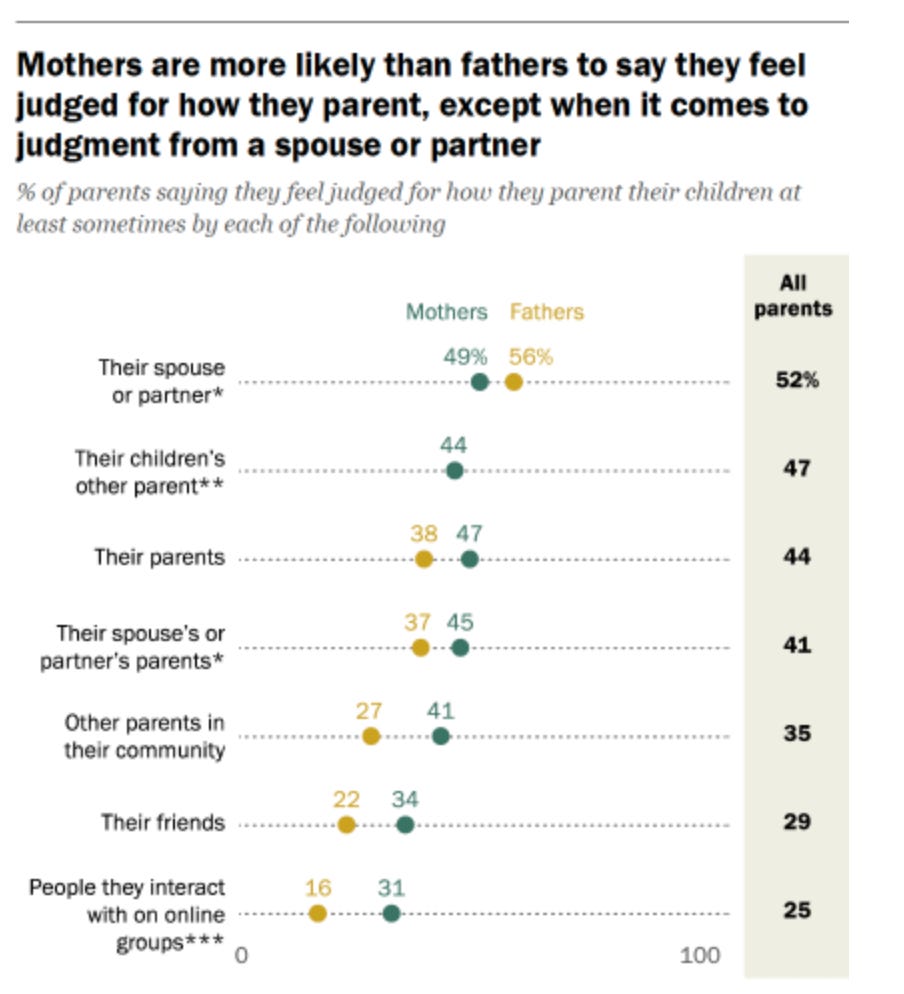
Of course, it’s not dads’ fault that moms get more judgement, and frequently it’s the moms doing the judging. (Check out that bottom number on the Pew survey for social media - moms are twice as likely to feel judged online). I think the best solution here is for moms to chill out and not give each other grief about all the little choices that go into parenting. Let’s find structural solutions to the things we actually care about from a public health perspective (like whether babies get enough time at home with their moms or the opportunity to breastfeed) and stop scolding individual parents.
In any case, perhaps reflecting their enjoyment of parenthood, plenty of dads are now voting with their feet and spending more time with kids than ever before. The Economist recently reported that, according to time-diary data, millennial dads are spending as much time with their kids as boomer moms once did. Indeed, men’s average daily childcare time has tripled since the 1960s. Although men’s time with kids has steadily increased over the last few decades, there was an inflection point around the pandemic, as many jobs went remote and public schools closed. This uptick seems to have engendered a sustained shift, and millennial dads are continuing to spend more time with their kids. The New York Times had a good recent summary of these trends, pulling data from a dashboard put together by the demographer Misty Heggeness that shows this upward trajectory.
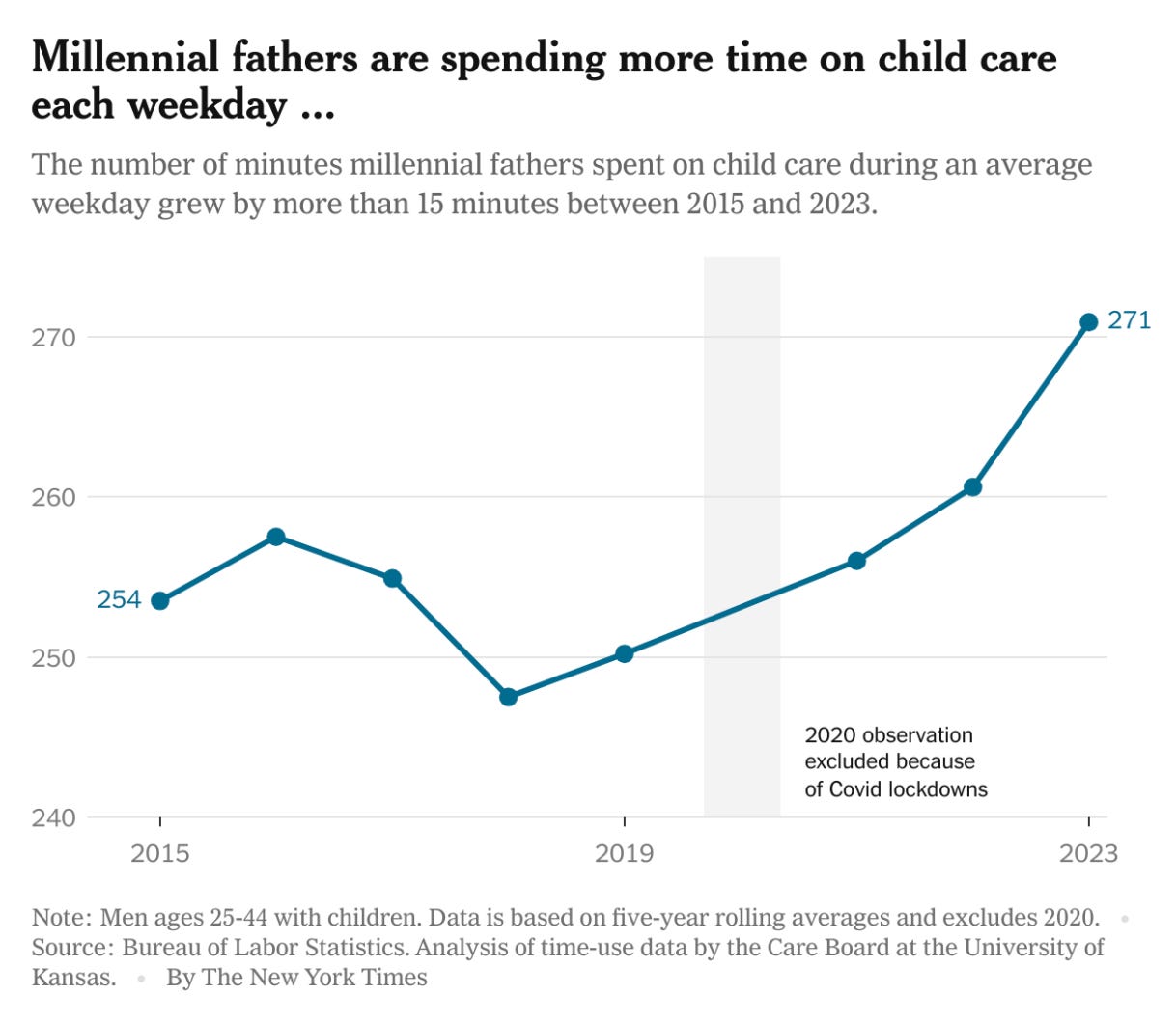
One interesting development is that fathering time has gone up most among dads with the highest educational attainment. This seems illogical when you consider that these dads have higher earning potential and in theory could get greater financial upside from time spent at work, but it tracks with the rise of intensive parenting as an aspirational, class-coded activity. Indeed, even though dads are doing much more than ever before, mothers’ parenting time has also gone up, so the mother-father gap in childcare time persists.
As dads spend more overall time with kids, they are increasingly taking on basic childcare and educational activities with kids (like reading to kids and checking their homework) in addition to spending time engaged in play. My guess is that we’ll see more convergence between mother and father parental happiness as fathers take on the less fun parts of childcare.
Not only might fathers start to look more like mothers in their childcare stress, I’d like to see mothers look more like fathers in their childcare enjoyment. We could all benefit from parenting in a more relaxed, less hypervigilant, less competitive, and less judgey way. Kelsey Piper had a great post in The Argument recently about how white-knuckle parenting is fueled by the mentality that parenting requires miserable self-sacrifice. You can reframe parenting as something that can be made interesting, which helps get through the irksome moments. The other key is to remember that parents in it for the long haul, even if the gratifications of parenting are not immediate. The everyday tedium adds up to something bigger and better: the sense of purpose that comes from devoting your time to caring for someone you love.
MUSIC RECOMMENDATION OF THE WEEK
Past recs (Playlist link!): Broncho // Alvvays // Capitol Years // The Cairo Gang and Hard Quartet // The Beths // Ballerina Black // James Mercer // Playboy Carti & Car Seat Headrest // Weyes Blood // Matthew Sweet // Fontaines D.C. // Elvis Costello Spanish Model // Lily Allen // Geese // Olivia Tremor Control // Wake Up Dead Man // Beulah // Rosalia // A$AP Rocky // Dirty Projectors // Mitski // Foxygen
TEENAGE FANCLUB
As a 9th grader in 1991, I spent a semester living in London with my mom and stepdad while my stepdad was teaching in Oberlin College’s Oberlin in London program. As a small town kid from the Midwest, living in a real city was dizzying and magical. During that time, I got into music in a new way. I had been a mega-Beatles fan as a kid (I watched the movie Hard Days Night every other Monday night for about two years), but as a burgeoning teenager, I started to get interested in youth culture and the idea that your music choices could make a statement about what kind of person you were. After school, I’d walk to the Tower Records on Kensington High Street. They published their own free music magazine, which was stacked up in piles near the front of the store, and I read it obsessively. That’s where I learned about The Sundays, PJ Harvey, and, of course, Teenage Fanclub, a formative influence for a generation of indie bands. Their 1991 album Bandwagonesque is a complete masterpiece. Just listen to the coda of The Concept!
It’s amazing to me how well this band holds up, 30+ years later. I think it’s because their music is so melodic. The tunes endure.
Did you know that I wrote a book, that it’s good, and that if you pre-order it, you get a free six-month paid subscription to my Substack? Redeem this offer here!
I think there is also a degree of differences in reporting?
When my kid was younger, we had the spreadsheet fight about hours, and we basically came to the conclusion that we had a 50/50 time split once we were using the same assumptions about what counted as 'child care' and what didn't. Some of this was dumb stuff, like 'playing video games with the kid' was something she did not want to count as 'childcare,' but she did want 'playing dolls with the kid' counted on her side. There was also kind of a divide, wherein 'housework' was counted, but yardwork or garage work was not. But it was extremely useful and settled a lot of conflict to actively log time spent on split home labor between the two of us.
What I came away with was an understanding that as the woman, my kid's mom was under more pressure to effectively be the queen of the home domain, whereas I didn't feel that pressure. The social pressure led her to continually kind of both underestimate my time and overestimate her own.
So it always seems to me that these surveys have results that would differ if you dropped cameras into 1,000 houses and then meticulously coded all the time spent on any given task.
Aside from intensive parenting being class-coded, its rational to use high earning potential to work less hours and spend more time on productive activities you enjoy. There's just no conventional way in US work culture to do that. I think many of us took the opportunity presented by work-from-home to sneakily rebalance our working hours and have continued to do so. Outside of companies run by certain notably workaholic public figures, most of Silicon Valley only half completed their return to office initiatives, and decided to be satisfied with only ~60% of staff showing up 3-4 days a week.