

How to win at Substack
Reflections on my first year, and five tips for success

Funny story: Whenever I write anything controversial on here, a handful of angry commenters come out of the woodwork to argue with me. A few months ago I started getting lots of comments on my posts from a character named Buck Walker whose profile picture featured an American flag made out of rifles. After a few exchanges, I started wondering why he was so persistent. I told my husband that I had a real weirdo on my hands. When I mentioned my interlocutor’s name, I heard snickering from my son’s bedroom. Turns out Buck Walker had been created by my 14-year-old son to troll me. Yes, that is correct, I was being catfished on Substack by my own child.
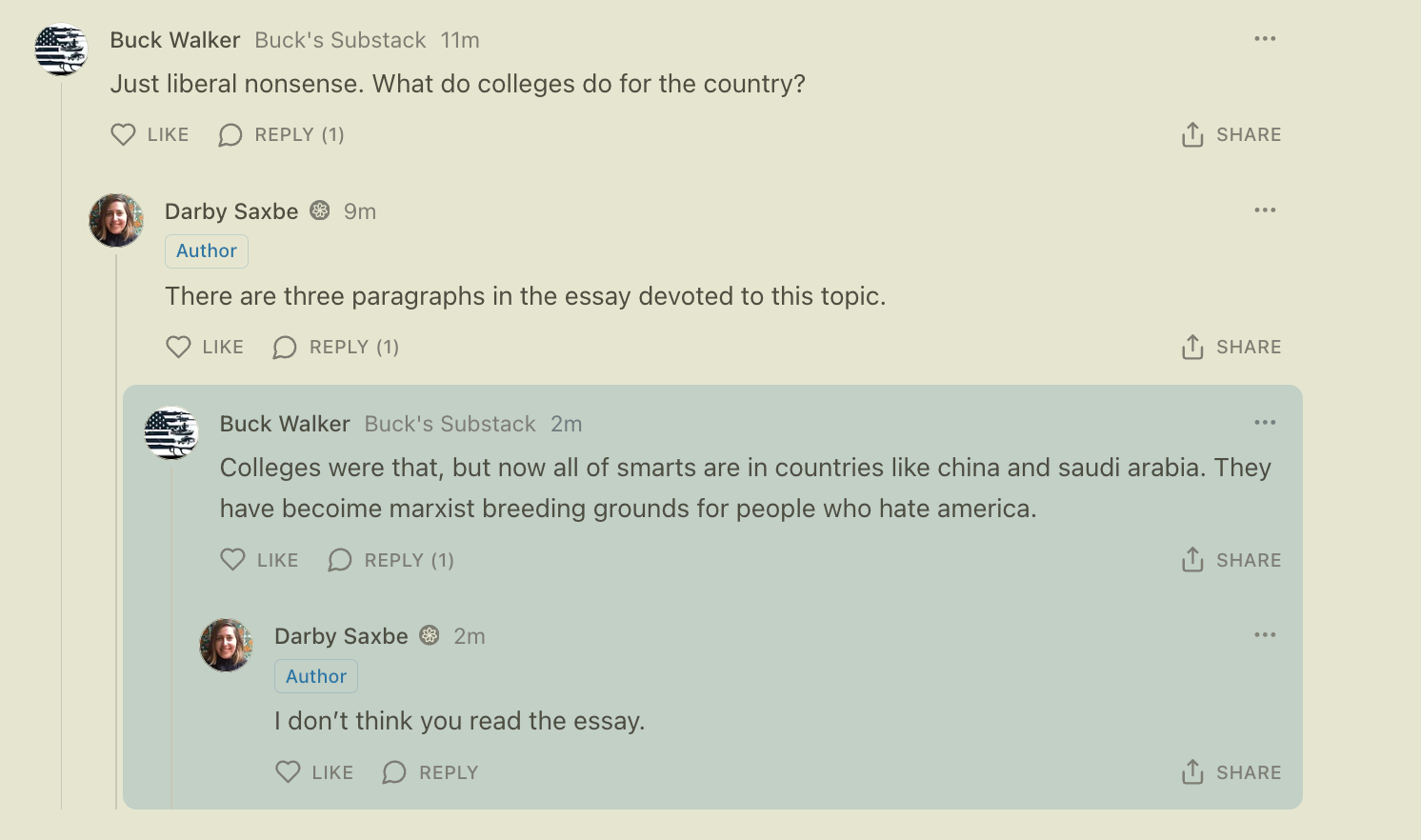
This story may reveal me as a terrible parent, but I thought Buck Walker was a very creative invention! In fact, I was disappointed when my son shelved Buck Walker, because I think he could have been a real star on Substack.1
The Buck Walker episode was a sign that I was spending way too much time on Substack. Want to be more like me? To commemorate the end of my first year on this website, I am sharing some reflections on how to succeed as a Substacker.2
You might be thinking, why should I take “winning at Substack” advice from someone who a) got trolled for weeks by her teenager and b) is clearly NOT one of the winners on here? After all, many accounts have more readers than mine. There are folks with hundreds of thousands of subscribers! I am a person with approximately twos of thousands, which pleases me greatly, but is certainly not top tier.
However, sometimes the wealth-maximizing strategies of the lower middle class are more useful than those of the top 1%. I’m out here hustling just like the other proles, and I’m ready to show you how.
1) Figure out what it means to “win.”
One way to make money at Substack is to write paywalled posts giving grow-your-Substack advice to people. The biggest bestseller accounts on here seem to be from folks who coach others on their Substack growth strategies, giving this site an oddly MLM quality at times. Many of these advice posts seem to be AI generated and feature creepy engagement-bait language about optimizing your branding and marketing.
Luckily, maximizing revenue is not the only way to succeed on here. Some folks just want readers, others want to persuade or find an outlet for their stories, others want to showcase their expertise, and others just want to recreate the golden age of Twitter.

When I first joined Substack my goals were to “build a public platform” and “sell books.” My first book release was coming up; as I’ve written, I showed up here after turning my manuscript, when I needed a place to put my anxious book-shaped energy. I also had a graveyard of unpublished op-eds to shed, and wanted more practice with non-academic writing.
After joining, I discovered new goals that eclipsed the others: “find community” and “make friends.” Plenty of people were already writing about topics I cared about, some of whom were on my radar before (like Elissa Strauss, Molly Dickens, PhD, Dr. Aliza Pressman, and Elliot Haspel), some of whom I’d “met” by reading their books or articles (like Nancy Reddy, Melinda Wenner Moyer, Stephanie H. Murray, Amanda Litman, Jo Piazza, Allison Daminger, Freddie deBoer, Matthew Yglesias, Derek Thompson, Paul Bloom, Kathryn Paige Harden, and Ruth Whippman), and some of whom I discovered after joining (like Eurydice, Dave Deek, Virginia Weaver, Cathy Reisenwitz, Mélina Magdelénat, The Cultural Romantic, Lirpa Strike, Kryptogal (Kate, if you like), Lisa Sibbett, Garrett Bucks, Elizabeth Kulze, Guen Bradbury, and many others). Talking to those people quickly became my favorite thing about Substack. It’s a gift to read something interesting and then get to interact with the person who wrote it. I still want to sell books, but I’m willing to concede:
2) Read the room.
The best friendship advice is “Be a good friend if you want to make a good friend,” and that’s also the best advice for writers on Substack who lack an established platform. Be a good reader if you want people to read you. Follow a bunch of people and read their stuff. Engage with it. Ask questions, make comments, and restack articles that you like with a note about why you liked them. I’m not talking about commenting on the biggest, highest profile accounts, or gadfly-trolling people to get them to respond to you. I’m talking about people with smaller followings who are just happy that someone read their work and took the time to write something nice. Most writers do not have big professional operations and are thrilled to get any engagement. Reading other writers will also help you find your niche. I started my newsletter with an interest in writing about pronatalism from a progressive angle, so following people interested in birth and parenting from different ideological perspectives sharpened my own thinking.
I especially appreciate the chance to engage with writers who disagree with me politically. A few to-my-right folks whose articles I enjoy include Lane Scott, Ivana Greco, Patrick T Brown, Helen Roy, Serena Sigillito, Stetson, Lyman Stone (who would definitely consider this post to be parasocial bootlicking), slightly-to-my-right folks like David Dennison and LastBlueDog, and plenty of others.
Subscribe a lot, and pay for subscriptions when you can. I think everyone’s mileage varies on how much they can afford to read and pay. I have too many subscriptions: 250, of which 23 are paid. My philosophy is to buy a paid subscription whenever anyone pre-orders my book or pays for a subscription to me, so that my spending and earning break even. Even so, I had to belt tighten when I did the math and realized I was paying 25x more for Substack writers than for my NYT subscription (which comes with giant roster of journalists).3 I try to mostly subscribe to small accounts that will benefit from my money, as opposed to big ones that already have tons. Still, there are a few bigger accounts that I think are consistently worth the investment, either because the writers publish a lot, have a unique perspective, or because their work is particularly well-sourced. Cartoons Hate Her, Elena Bridgers, and The Argument are all big accounts whose paid subscriptions are consistently high-value.
3) Get in conversation.
Just as response videos are an algorithmically optimized YouTube genre, response posts also seem to get traction here, because they pick up on a topic that is already catching readers’ interest.4 Restacking is just the beginning. You can also write whole takedown posts, or annoy folks into publicly disagreeing with you. In my first couple of months on here, I wrote a few posts about why pronatalists should favor immigration that attracted ire, and got into an antagonistic back and forth about IQ hereditarianism with an account with many times my follower count. Much to my surprise, I opened Substack a day later to find a 10,000 word post dissing me! I thought about quitting this site in chastened humiliation, but then I got kinda mad, and also realized that the diss-post made some good arguments, so I wrote a response, which got more views and subscriptions than anything else I’d written before. I guess the lesson there is that it’s good to bait people who have the bandwidth to write point-by-point takedowns. A few months later, my favorite mean pronatalist wrote a takedown of another one of my posts, which inspired me to reply back, and that post netted another flurry of new subscribers, too.
My most subscriber-generating post by far was about whether we are mad about feminism or capitalism. It started with me disagreeing with one of Elena Bridgers’s essays, and our back-and-forth elicited takes from Cartoons Hate Her, Esther Berry, jonah, Charles Olney, Cecelia Thorn, and Virginia Weaver, and others. I love it when lots of writers start talking about the same topic. My most recent post was about screen time, and I was inspired to write it because Dorota Talalay had written a great post about screens that had lots of folks jumping in, from Drunk Wisconsin to aelle.
Another way to get into conversation is to do cross-posts and collaborations with other writers on here. I was thrilled when The Gender Nerd reached out to me to talk about dad brain stuff, and she’s become one of my favorite writers to follow. I also loved getting to compare notes on academia with Daniel Muñoz in a Substack Live.
4) Use the Notes feed wisely
People love to hate the Notes feed, because it turns Substack into a social media website and not just a place to find long-form essays. But I like it, because I’m sick of all the other social media websites: Twitter is a cesspool, Bluesky gets annoying, LinkedIn is creepy, Facebook is for boomers, and Instagram is too performative. I like Substack because most of the folks lurking around the Notes feed are writers themselves, and a quick-take post is usually a portal to a longer and thoughtful essay.
Notes are also a good way to float an idea and see if it gets traction. Some of my favorite posts have come out of conversations started on Notes. I wrote a note about how I discovered an AI summary of my research that got the details wrong, and was surprised by how many people reacted to it. That was my cue to write up the experience in more detail. I also posted a note about the mass firings of staff people at my university that got a lot of hate, and motivated me to write a longer piece about DEI at universities. Similarly, The Argument reached out for me to write something about the science of gender difference after I posted a note on the same topic that garnered lots of engagement. Most recently, a note about the problem with tradwives made me want to write more about marriage and monogamy.
Weirdly, I gain more subscribers from posting notes than I do for writing full-length posts. In fact, I lose a few subscribers every time I post a newsletter. That’s depressing, but I try to think about it as a kind of healthy pruning and culling process (much like the parental brain). If you’re writing newsletters in your wheelhouse, then unsubscribers are not your target audience anyway.
5) Write consistently
Before I started my lab I didn’t have any good research ideas. Once I had my lab set up and collecting data, I kept thinking of more, and now I have way too many. The more plugged in you are, the more the ideas will flow. For me, trying to post once a week helps me stay engaged and seems to help readers find me, too.
I keep a running list of ideas and add to it whenever I get a brainstorm. I’m kind of ADHD and like to start things more than I finish them. If I’m really excited about an idea I’ll start a Word doc and bang out a few paragraphs. Then I’ll close it up and do something else. I might occasionally open up the doc and add a sentence or two when I think about it.
A couple of other times I’ve started a piece by opening up a text message to myself, selecting ‘voice to text,’ and talking through an idea out loud. I’ve done this while driving, while walking, and at the gym. Since I have my computer set up to receive text messages, I can cut and paste the text into a Word doc later on.
That means that when a week has gone by and I feel like I ought to post something, I have a few half-baked half-essays already written, and it’s a matter of building and polishing rather than having to start an idea from scratch.
One thing I don’t do is let AI help me write, because I find that it bakes in a bland, obsequious style that is tough to edit out later. For me, writing is thinking – it’s how I muddle through something – and skipping that stage means that my ideas never feel as clear. I have occasionally used AI to get a top-level view on a research area that is unfamiliar to me, but I find that even when I ask it for verified information, it still hallucinates. The last time I asked AI to give me citations and summarize findings, it got the details backwards, generating take-aways that were the exact opposite of what the papers actually said. I usually end up quitting in frustration and doing my own research.
After the paywall, I’ll get more granular and tell you more about the pace of my Substack subscriber growth, my most and least popular posts, the Notes that have garnered the most subscribers, and my theories about why. You can pay for a subscription the normal way, but if you’d like to pre-order my book instead, I’ll upgrade you to a paid account and you’ll get a book AND a subscription. See a pitch for why you might like my book, and more info about how to get this deal, here.