

How music changes the brain
What teaching music to kids can tell us about neuroplasticity

As a researcher who studies how parenthood changes the brain, I’ve always got my antennae up for scientists who are studying other forms of neuroplasticity that emerge within windows of development, transition, and learning. Luckily for me, one of these researchers works in my department, and she’s been tracking a sample of kids in a youth orchestra program to see how musical training affects their brain development. She recently gave a talk in which she shared such fascinating results from her decade-plus study that I asked her for permission to write about them here. Even if you only made it through a year or two of piano lessons before bailing out, as I did, her research is relevant to everyone who cares about music— especially people with kids or people who work in education.
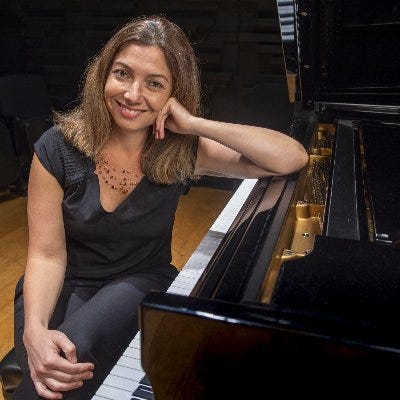
Assal Habibi was trained as a classical pianist and spent two years studying music in Strasbourg, France. She pivoted to neuroscience research, ultimately earning a Ph.D from the University of Irvine, but held on to her passion for music. She joined the University of Southern California as a postdoctoral fellow and is now a faculty member and director of USC’s Center for Music, Brain, and Society. Over the last 12 years, she has been studying how music transforms the brain.
In order to examine the effects of music training on children, Habibi and her co-investigator, Beatriz Ilari of USC’s Thornton School of Music, partnered with a program offered by the Los Angeles Philharmonic, YOLA (Youth Orchestra Los Angeles). YOLA is an intensive program that offers free group-based music training to kids, with an emphasis on collaboration and performing together. She recruited kids before they formally started in YOLA, and then followed them every year for the five years, with an additional follow-up in year seven. In other words, Habibi literally watched these kids grow up, from elementary school age all the way into adolescence. By scanning the kids repeatedly over time in an MRI scanner, she was able to see how participating in the youth orchestra affected their brains.
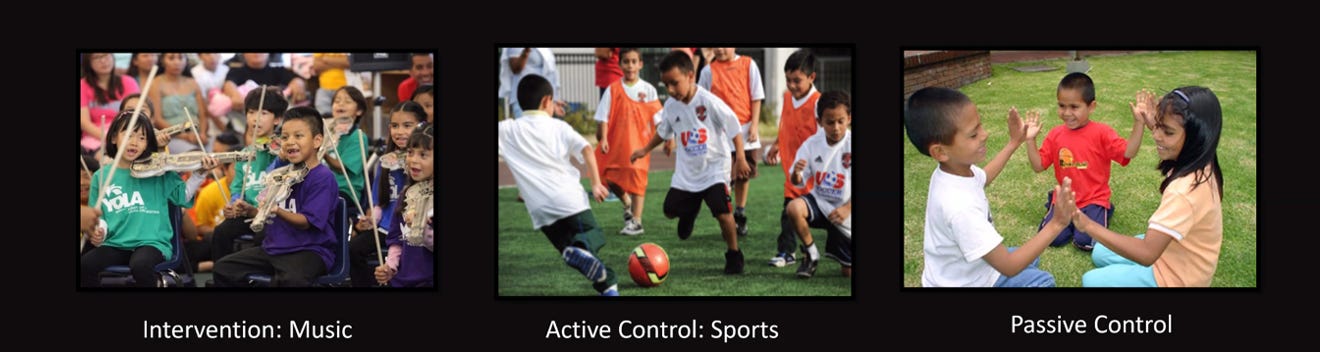
Habibi and Ilari recruited two comparison groups of similarly-aged children whom they followed over the same time intervals, so as to ensure that any effects she detected were specific to music training and not just to kids’ overall development over time. One was a passive control group who wasn’t assigned to any special programming. But Habibi also wanted an active control group, so she could control for some of the aspects of the music training program that weren’t specific to music, like the fact that it was structured, group-based, and challenging. She decided to simultaneously follow a group of kids who were enrolled in a youth sports program.
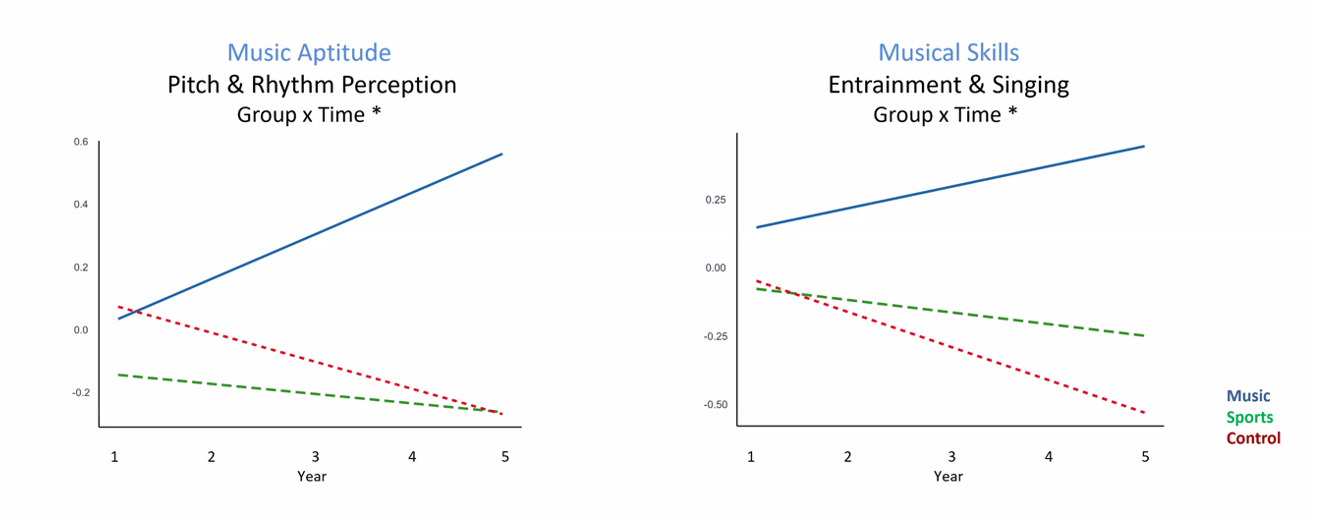
So what did Habibi find over five years of following these kids? First, unsurprisingly, they got better at music! Controlling for their cognitive abilities, here’s how their pitch, rhythm perception, and musical skills improved over time. The blue line shows the music group, which clearly improves while the sports and control groups stay fairly flat:
Habibi’s group also looked at the children’s auditory encoding – how does sound get encoded within the auditory areas of the brain? They gave the kids a pitch perception task and used EEG (electroencephalogram) recording to measure the electrical activity in the brain. Their results indicate that kids in the music group could interpret sounds more effectively and efficiently. Their brain responses indicated a more mature pattern of processing in the music group - in other words, they looked more like young adults than young kids in their ability to process musical pitch.
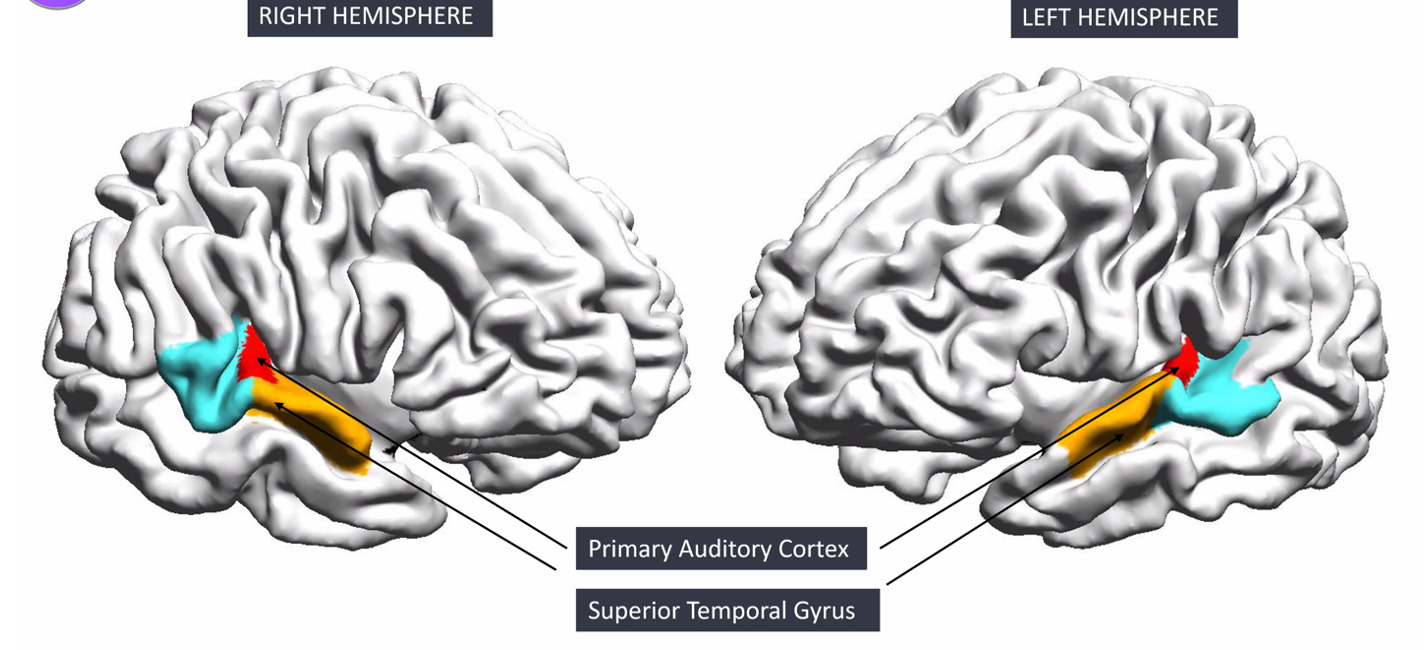
Kids in the music group had different patterns of cortical thickness in the auditory cortex and in the superior temporal gyrus, which plays a role in auditory processing, suggesting that the music training was jumpstarting the more mature development of these brain regions.
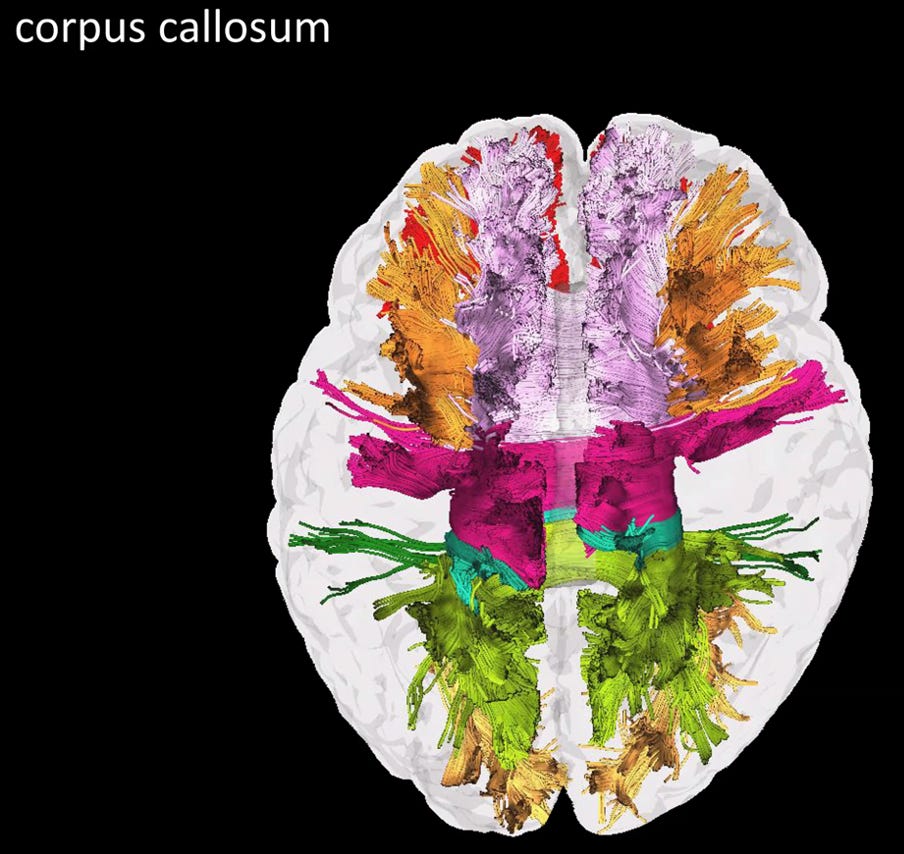
Habibi’s group also performed a type of neuroimaging called Diffusion Tensor Imaging (DTI), which can measure the structural connectivity of the brain by looking at white matter fibers, which form myelin tracts linking different regions together. In addition to being a really interesting way to look at the brain, DTI yields stunningly beautiful images, as shown below. Habibi’s DTI analysis found differences in the white matter integrity of the corpus callosum, the bundle of fibers in the middle of the brain that connects the left and right hemispheres. Children in the music group showed corpus callosum patterns indicating more integration across the brain, especially of the frontal areas. This makes sense, because in order to hear and play a piece of music, you need to be able to coordinate disparate brain functions together, including your auditory processing, your motor actions, and your executive functioning (thinking and planning).
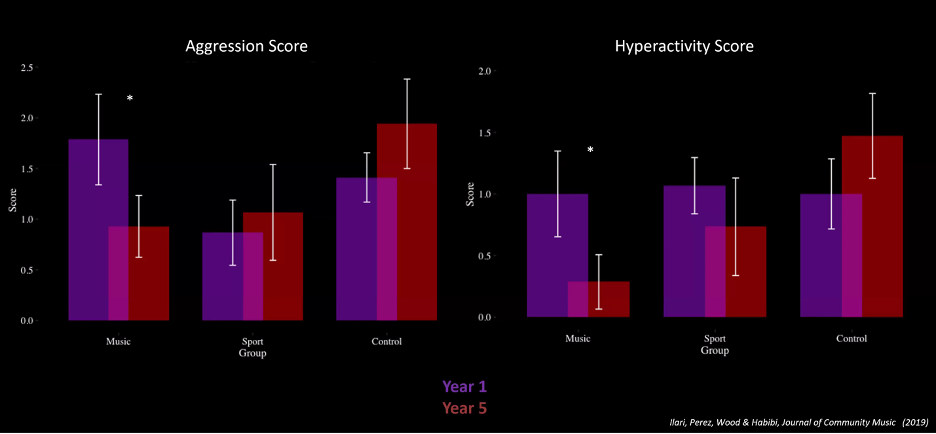
In addition to showing up in the brain, Habibi also found that the effects of music training showed up in the kids’ behavior. According to parent reports, kids in the music group were less aggressive and hyperactive than kids in either of the other two groups. You can see this in the figure below. In the first year of the study (the purple bars), the music, sports, and control groups had fairly equal levels of aggression and hyperactivity. But by the fifth year (the red bars), the kids in the music group were clearly less aggressive and hyperactive than the kids in the control group, with the sports group right in between.
Kids in the music group also showed a better ability to delay gratification. Habibi’s group gave them a delayed discounting task where kids could either choose a smaller but immediate reward, or choose to wait longer for a bigger reward. You may have heard of the marshmallow task, in which kids can eat one marshmallow right away or wait and get two marshmallows. This is a delayed discounting task, and Habibi gave a similar task to kids in her lab. As the figure below shows, kids who had gotten musical training could wait longer than the kids in the control group for a bigger reward, with kids in the sports group in between.
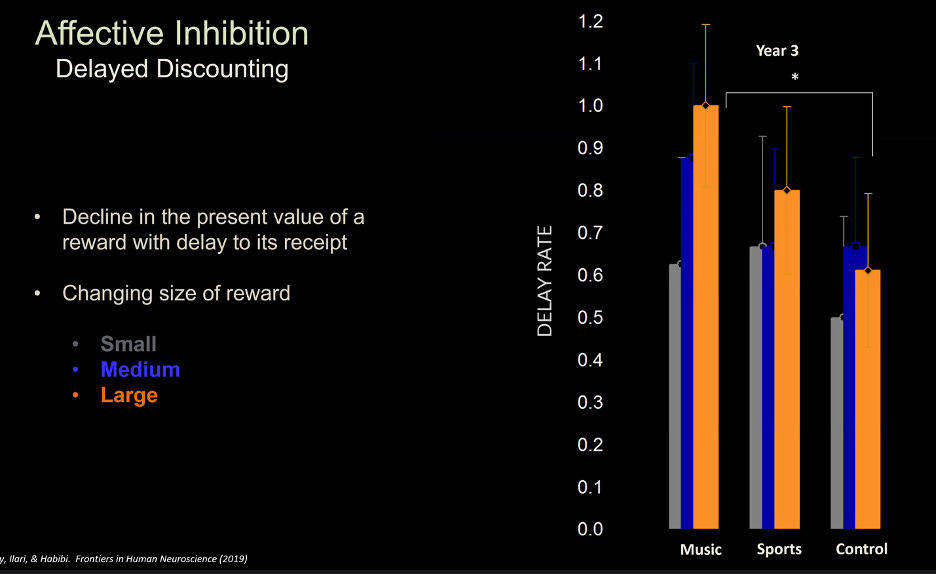
The figure shows results from the third year of the study. By the fifth year, when the kids were all entering adolescence, the kids in the control group were starting to match the performance of the kids in the music group. In other words, all the kids eventually developed the ability to delay gratification, but the kids who got music training got there faster, at an earlier age.
Along similar lines, Habibi also found that the more musical training kids received, the better their working memory performance - with the greatest benefits in the first few years of training, leveling off as the kids got older.
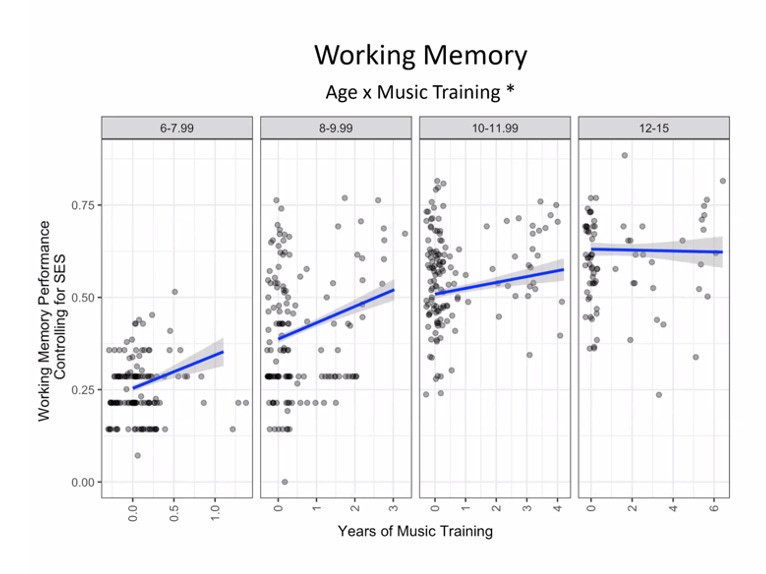
In summary, Habibi’s research found that musical training conferred a number of benefits to these kids beyond just musical skills, ranging from more efficient auditory processing in the brain, to greater integration across the left and right hemispheres, to reduced aggression and hyperactivity, to improved executive functioning (like working memory and the ability to delay gratification). Many of these benefits were most pronounced in the first few years of musical training, and the differences between groups seemed to level off as the kids got older, flattening out around age 10. However, given that ages six to 10 are crucial elementary school years for learning the basics of reading, math, and classroom behavior, these early benefits had the potential to set the kids up for longer-term success.
Habibi’s research contributes to our broader understanding of neuroplasticity in middle childhood, demonstrating that there is tremendous potential to reshape kids’ brains and behavior through enrichment. Her work also points to the potential of publicly funded, widely accessible arts programs to improve not just kids’ skills, but their self-regulation and cognitive development. Importantly, the kids in the YOLA program were not affluent or privileged, and their families would likely not have been able to afford private music lessons on their own. As public schools are increasingly cutting and defunding music programs, her studies help to show us that music training is not just a fun perk or a fancy extra — it literally helps to build kids’ brains.
Such an important point. Music isn't just enrichment. As schools cut arts budgets, it’s easy to dismiss music as “extra,” but the science tells a different story, thank you for backing it up with evidence from research. The real question is, can we afford not to invest in it?
Great research! The comparison between music and sports is so interesting, especially because I think we have a kind of shared cultural discourse around athletic practice and effort that leads parents to think that with enough investment most kids can become at least proficient at a sport. But we tend to look at musical ability as something that's natural or innate, and relies on preexisting talent. Given all of the benefits of music for kids (as demonstrated by this research) it's really a pity that we don't give more kids these opportunities to learn and develop over time. Not to mention that you can be in a choir or a community orchestra or play the piano for a lifetime....lacrosse or soccer, not so much.